

no fluff, just truth, clarity & shared experiences!
Taking you behind the scenes and beyond the brand to help you create more alignment and ease in your business.

Host, Sarah Glenn is the unapologetically honest voice behind BRAND(ed) and goes beyond the surface-level trends to pull back the curtain on what it really takes to grow a business from the inside out.

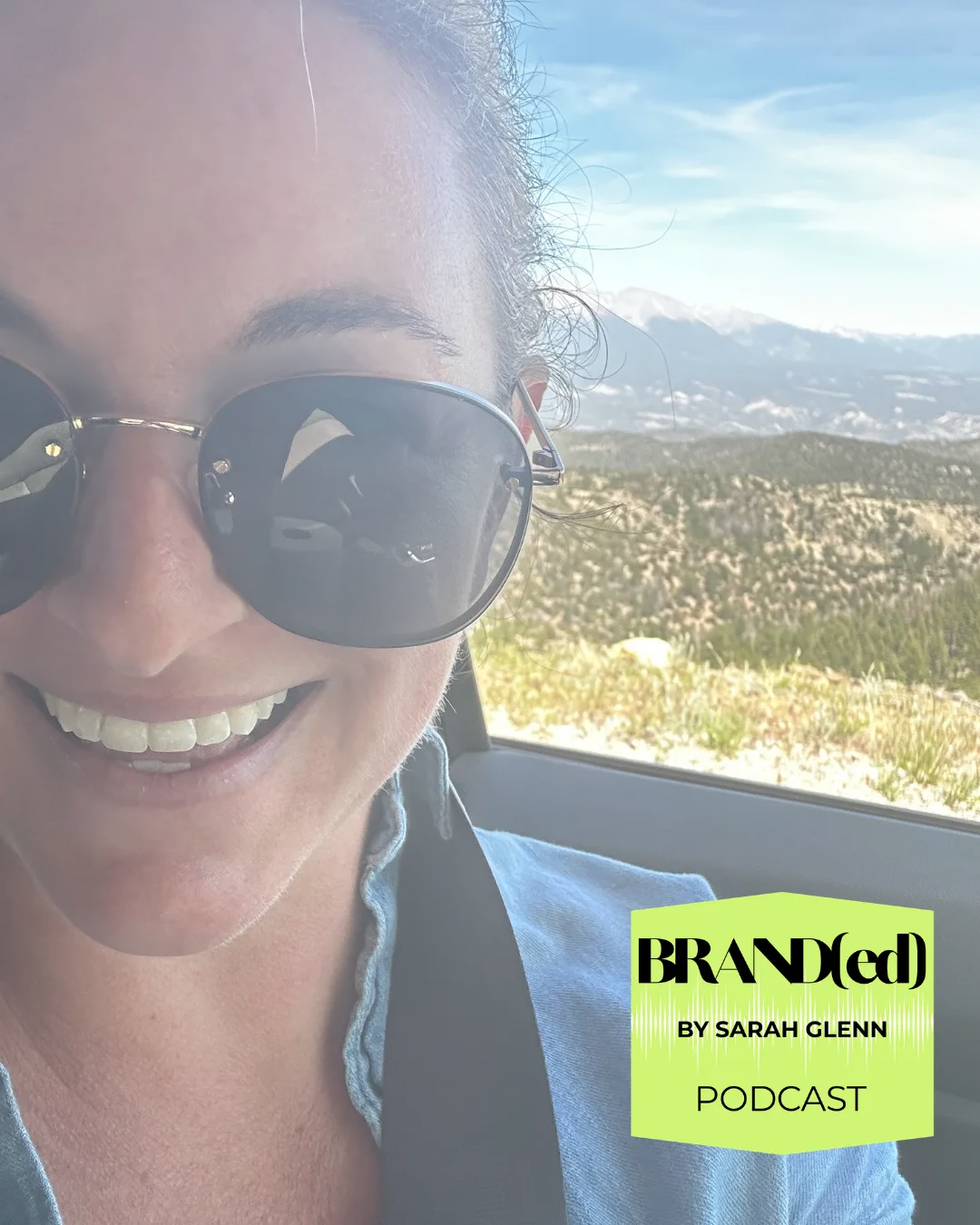
I'm a small-town Texas girl now living in the mountains of Colorado. From starting my own show with no clue what I was doing to recording over a hundred episodes anywhere I can find a quiet spot and some Wi-Fi, this podcast has always been about having honest (and often vulnerable) conversations with you!
I'm obsessed with design and often wake up in the middle of the night to jot down podcast ideas and design concepts. I crave sunshine and nature, and you'll find me bare foot in the grass over a ballgown any day.
I love to create beautifully designed websites, seamless systems, and compelling email marketing. Specializing in quieting the noise and clarifying the vision, so you have the clarity you need to focus on high-impact work that maximizes your time.
Binge The
latest episodes
You Don't Have to Prove It Anymore — Four Things Established Founders Quietly Stop Doing
You Don't Have to Prove It Anymore
There are things that established business owners gradually stop doing. No announcement. No pivot post. No explanation of what changed or why.
They just stop. And the stopping, from the outside, can look like scaling back or pulling away or going quiet. But what's actually happening is the opposite of that.
This post is about four of those things. And more specifically about the through line connecting all of them that I think is worth naming directly.
They stop documenting the hustle
At some point, the content about how hard you're working starts to feel like the wrong kind of content to be making. Not the genuine behind-the-scenes stuff that connects people to the real experience of building something. The other kind. The kind that's really about proving effort.
The 5am posts. The exhausted but grateful captions. The this week nearly broke me content. The performing of work rather than the sharing of it.
Here's what shifts. When you stop needing to document the effort, what replaces it is the thinking. The observation. The conclusion reached after doing the work privately. The work becomes invisible. The output of the work becomes the content.
And there's a quality to showing up with the result rather than the process that reads differently to an audience. It feels settled. Established. Like someone who doesn't need to document the effort because the effort is self-evident in what they produce.
The hustle content was always, at least in part, about reassurance. Reassurance to the audience that you deserve what you're building because look how hard you're working for it. When you stop needing that reassurance, the content changes. And the audience feels the difference even when they can't name it.
The question worth sitting with: are you still making proof-of-effort content because it's producing results? Or because some part of you still feels like you need permission to stop?
They stop justifying their prices
There's a phase most business owners move through where pricing comes with a defense. Here's everything that's included. Here's the value breakdown. Here's the limited-time offer. Here's why this is actually worth more than what I'm charging.
All of that is justification. And justification sends a signal to the buyer, however unintentional: the price might not hold on its own. That there's a conversation to be had. That the number is a starting point rather than a statement.
Here's what happens when you stop. You say the number. You let it sit there. No breakdown. No apologetic framing. The price is what it is because the work is what it is.
And something counterintuitive tends to happen. The confidence the pricing now projects becomes more persuasive than the explanation that preceded it. Because the right client isn't looking for a breakdown. She's looking for a signal that you actually believe in what you offer. And nothing signals that more clearly than a price that doesn't need to be defended.
The question worth sitting with: if you removed the justification from your next offer announcement and just named the price, what would stop you from doing that?
They stop being available everywhere all the time
This one tends to happen the most quietly. Nobody announces they're becoming less accessible. It just gradually becomes true.
Slower email responses. Fewer platforms. More selective about which calls get taken. Not constantly present in every space the audience occupies.
And here's what that scarcity, when it's genuine rather than manufactured, communicates. It communicates that your time has real competing demands. That access to you is not unlimited. That the people who do get that access are getting something that isn't available to everyone at any moment.
When you're everywhere all the time, you're signaling something about the demand for your time. Even unintentionally. The founder who responds to every DM within minutes, who's active on every platform daily, who takes every call, is communicating her capacity whether she means to or not.
The interesting thing about becoming less available is that you don't lose your audience. You filter it. The people who stay are the ones who value the access enough to work a little for it. And that audience tends to be significantly more ready to buy than the one that accumulated because you were easy to reach.
The question worth sitting with: does your current availability reflect where you actually are? Or is it a habit from an earlier stage that hasn't been revisited yet?
They stop teaching everything for free
This one tends to come with the most guilt. Because there's a persistent belief in the online business space that giving more free value is always better. That the more generous the free content, the more trust it builds.
But there's a distinction worth making that changes the whole conversation. The distinction between sharing perspective and sharing methodology.
Perspective is the observation, the insight, the way of looking at something that only comes from being inside the work. It makes people think differently about their own situation. It creates resonance. It's genuinely valuable and impossible to replicate without the experience behind it.
Methodology is the how. The framework. The step-by-step. The thing someone could take and implement without a relationship, without context, without the specific application to their specific business.
When you shift from sharing methodology to sharing perspective in your free content, something clarifies. The free content gets sharper because it's doing one specific job: demonstrating how you think. The paid work gets clearer because it's doing a different job: applying that thinking to someone specific.
The guilt about where you draw the line tends to dissolve once that distinction is clear. You're not withholding. You're recognizing what the paid work is actually for.
The question worth sitting with: is your free content doing the paid work's job? And if so, what would shift if you drew a cleaner line between the two?
The through line
Every single one of these four things is a form of proving.
Proving you deserve what you're building by showing how hard you work for it. Proving the price is fair by explaining the value. Proving you're present and accessible by being everywhere. Proving your expertise by giving away everything you know.
And at some point, the proving stops being necessary. Not because you become arrogant or stop caring about the people you serve. Because you reach a point where the proof is in the work itself rather than in the performance around it.
That shift, from proving to simply being, is what most people are reading when they look at established business owners and sense that something feels different about how they show up. The performance around the work has fallen away. What's left is just the work.
The question to sit with
Is there something you're still doing primarily because you feel like you need to prove something?
Not because it's producing results. Not because it's genuinely serving the people you're trying to reach. Because some part of you feels like stopping would look like you're not working hard enough, or charging too much, or not giving enough.
Because here's what I keep observing. The business owners who stop doing these things don't stop because the results got bad. They stop because the results got good enough that the proving stopped being necessary.
You don't have to announce the stopping. You don't have to explain it. You just gradually stop.
And the stopping is part of what makes you more visible. Not less.
🎧 Listen to Ep.189 | The part of your business you’ve outgrown without realizing it



@ Copyright 2025 - Social Jane Media | All rights reserved


