
no fluff, just truth, clarity & shared experiences!
Taking you behind the scenes and beyond the brand to help you create more alignment and ease in your business.

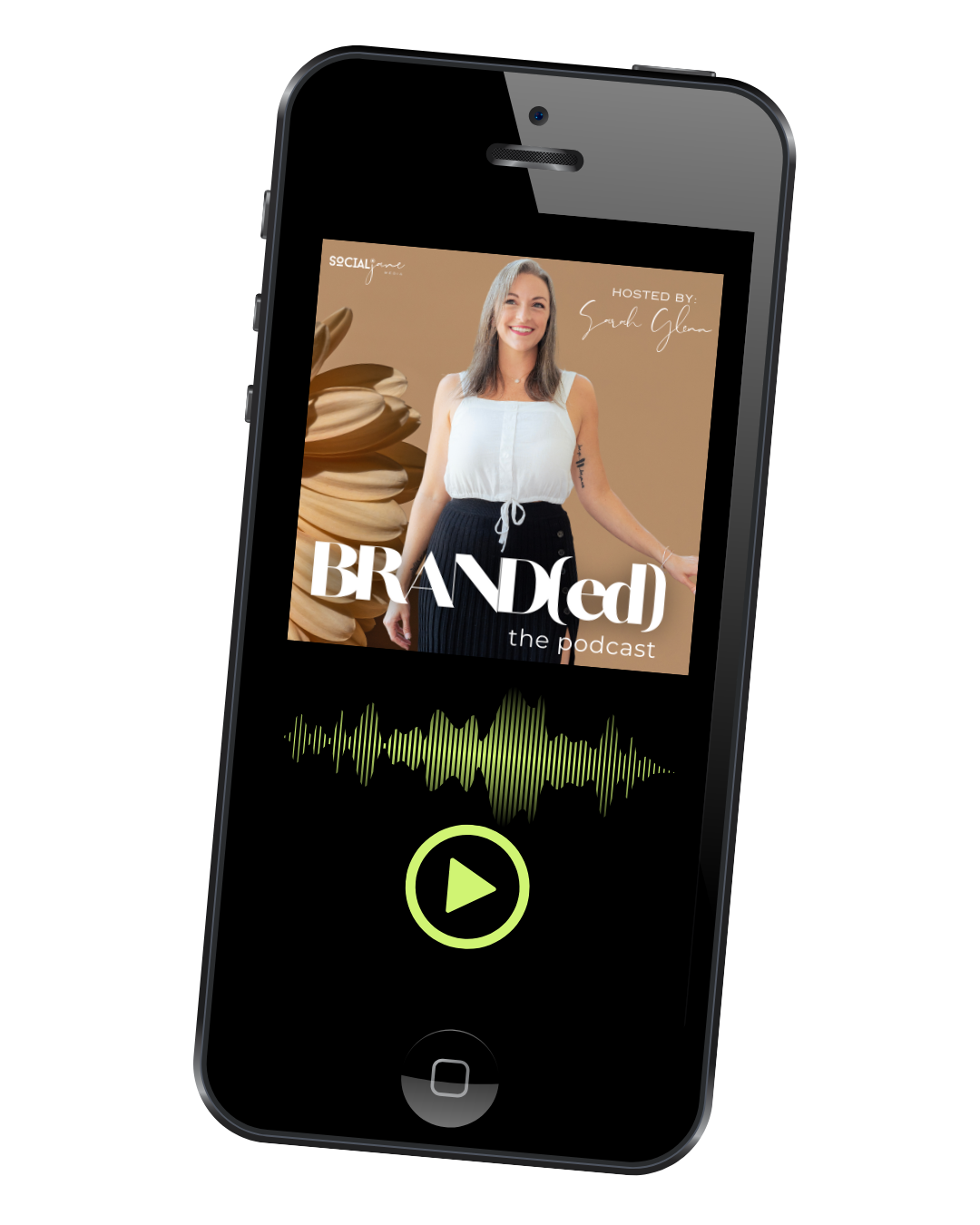
Host, Sarah Glenn is the unapologetically honest voice behind BRAND(ed) and goes beyond the surface-level trends to pull back the curtain on what it really takes to grow a business from the inside out.

I'm a small-town Texas girl now living in the mountains of Colorado. From starting my own show with no clue what I was doing to recording over a hundred episodes anywhere I can find a quiet spot and some Wi-Fi, this podcast has always been about having honest (and often vulnerable) conversations with you!
I'm obsessed with design and often wake up in the middle of the night to jot down podcast ideas and design concepts. I crave sunshine and nature, and you'll find me bare foot in the grass over a ballgown any day.
I love to create beautifully designed websites, seamless systems, and compelling email marketing. Specializing in quieting the noise and clarifying the vision, so you have the clarity you need to focus on high-impact work that maximizes your time.
Binge The
latest episodes

The Bonus Is a Bribe. And You Know It. — The Discount Spiral Most Founders Won't Name
The Bonus Is a Bribe. And You Know It.
There's a pattern inside a lot of launches right now that makes complete sense from the inside and looks very different from the outside.
It starts small. A bonus added the week before cart opens. Something that feels like it rounds the offer out, gives one more reason to say yes, makes the value feel more complete.
And then mid-launch another thing gets added. The payment plan becomes more flexible. A FAQ shows up on the sales page because the copy isn't quite saying it right. Another bonus appears because the first few days were quiet.
By the time cart closes the offer looks significantly different from what it was when the launch began. More included. More generous. The price technically unchanged but attached to something that costs considerably more to deliver.
Most founders call this over-delivering. This episode offers a different name for it.
What's actually happening
The pattern has a name. The discount spiral. And it almost never starts with an intention to discount. It starts with a confidence gap.
When you fully trust your price, you don't feel the pull to add things. The offer is what it is. You present it clearly and leave it there. The price holds because you hold it.
But when there's a gap between the confidence you have in the work and the confidence you have in the price, something else happens. The adding starts. One more bonus. One more reason for someone to say yes. One more way to make the value feel undeniable before anyone has even questioned it.
And the adding feels like generosity. It feels like investment in the offer. It looks like caring about the buyer's experience. But what it's actually doing is negotiating against yourself before anyone has objected to the price.
Buyers feel this. Not always consciously. But there's a difference between an offer being confidently presented and an offer being nervously supplemented. And established buyers, the ones you most want in your work, respond to solidity. They want to feel like they're buying something decided. Something built properly and offered without apology. Not something being assembled in real time to address objections that haven't even been raised yet.
An offer that changes mid-launch is communicating something. It's communicating that it wasn't quite ready. That the person selling it is still figuring out what it is. And that communication, however unintentional, can undermine the conversion the additions were designed to support.
The margin math nobody is running
Here's the part that doesn't get examined honestly enough.
Every time something gets added to an offer mid-launch, the margin on that sale changes. Not the price. The margin. Because the price stays the same but what's being delivered in exchange for it keeps growing.
If the additions require time, energy, or personal involvement to deliver, the margin on that offer is quietly shrinking even as the revenue number stays constant. You're selling at the price you set. But what you're actually earning per client, when you account for the additional delivery, is less than it appears. Sometimes significantly less.
And this compounds across launches. The offer grows. The delivery cost grows. The margin shrinks. And there's a persistent sense that the revenue looks right but the profitability feels off and it's hard to pinpoint why.
This is why. The quiet negotiation that happens before every launch, where the offer gets amended to accommodate the confidence gap, has a real cost that doesn't show up as a line item anywhere. It just shows up as a business that's working harder than the numbers suggest it should have to.
What the pull to add is actually telling you
When you feel the urge to add something to an offer mid-launch, that urge is information. Not about the offer. About your relationship to the price.
Because if the price were exactly right and you knew it, you wouldn't feel the pull. The offer would be what it is. The adding would feel unnecessary rather than reassuring.
So instead of following the pull, it's worth pausing and asking what it's actually about.
Is there something about the offer itself that genuinely needs to be improved? If yes, the right move is to improve it before the next launch. Not to add compensation during this one.
Is the price misaligned with the offer? If yes, the right move is to address the pricing. Not to increase the delivery to make a too-high price feel more justified.
Or is the offer solid and the price right and the pull is really about the gap between how you think about your work and how you've been trained to think about charging for it? If that's what's happening, the work is internal. Adding bonuses doesn't address a confidence problem. It papers over it until the next launch.
In any of those three cases, adding something mid-launch is the wrong response to the right diagnosis. The real issue survives the launch. And it shows up again next time.
What a solid offer looks like
A solid offer is one you can present once, clearly, at the price it deserves, and leave exactly as it is from the moment you open cart to the moment you close it.
The page doesn't change. The bonuses don't multiply. The payment plan doesn't quietly become more flexible in response to the silence of the first few days. The offer is what it is because it was built properly before the launch began.
And when you present it that way, something shifts in how the launch feels. There's a calm to how you show up when you're selling something you're not simultaneously negotiating with yourself about. The emails feel different. The conversations feel different. The way you answer questions about the offer feels different. Because you're not half promoting and half justifying. You're just promoting.
And that clarity, that singular focus on the conversation with the buyer, is part of what makes the offer more compelling. Not the bonus. Not the flexible payment plan. The confidence underneath the presentation.
The question worth sitting with
Before the next launch, look at your offer and ask honestly: is everything currently included something you would have put there if confidence were complete and price were no question?
Or did some of it find its way in because some part of you wasn't sure the offer would hold without it?
The additions that came from genuine value creation are worth keeping. They make the offer better. But the additions that came from the confidence gap are worth examining. Because they're not making the offer better. They're making you feel safer about presenting it. And those are two very different things with very different solutions.
The offer is probably worth more than you're treating it as. And the version of it that gets presented with full confidence, without the mid-launch amendments, is almost certainly more compelling than the version padded with compensation.
Trust the work. Present it clearly. Let the price hold.
Ep.190 | Your Offer Doesn't Need Another Bonus… it Needs Your Confidence


@ Copyright 2025 - Social Jane Media | All rights reserved


